News
Multi-layered Capabilities for the Modern Battlefield

Battlefield dominance is being redefined by the convergence of AI, manned-unmanned teaming and hybrid power.
These innovations accelerate decision-making, enhance reach and resilience, and determine how swiftly militaries can sense, decide, and act — staying one step ahead of their adversaries.
Beyond individual platforms, with greater emphasis now placed on unmanned systems, land capabilities and resilient supply chains — reflecting the reality of modern, multi-domain operations. Recent conflicts in Europe and the Middle East have underscored a crucial lesson: technological advantage is only valuable if it can be integrated, sustained and adapted under real operational pressure.
Imagine a forward operating base in a chaotic city centre, where every sound counts – engines, radios, footsteps. In such an environment, stealth is not an option; it can be the key to avoiding detection. That’s where hybrid electric drive (HED) vehicles come in.
HED allows troops to switch to silent electric mode, effectively concealing their position when it matters. Even more importantly, it provides deployed forces with dependable exportable power at the point of need. Platforms can sustain command posts, sensors, radars, unmanned vehicles and electronic warfare systems without reliance on exposed, noisy generators. The result is a lighter logistics footprint, longer mission endurance and greater flexibility for commanders operating at the edge. Silent electric running is available when concealment is required, but the real operational value lies in delivering sustained power where it is hardest to provide.
“Export power means mission flexibility. When your platform can directly power command systems, unmanned assets, and energy-hungry payloads like Direct Energy Weapons - without mobile generators - it gives Manned Unmanned Teaming (MUM-T) forces a decisive edge.”
said Jensen Chew, product director for electrification and 4x4 vehicles at ST Engineering.
Acoustic and thermal signatures are reduced, allowing low-heat ‘silent watch’ operation. On an 8X8 platform, this equates to roughly 25 km of near-silent movement and up to 24 hours on standby. Fuel use falls by around 30 per cent, easing pressure on already stretched supply chains. Live demonstrations at these events are expected to showcase both off-road performance and power export under simulated threat conditions.
Unmanned systems are pushing operational stand-off even further. The TAURUS is a multi-role Unmanned Ground Vehicle (UGV) that features customisable modularity and mobility superiority. Towable with regenerative fast charging, it can carry supplies, evacuate casualties, mount remote weapons, conduct surveillance or deploy smaller drones as required. Its all-electric drivetrain delivers up to 20 kW of configurable DC or AC power, turning it into a forward energy hub. Equipped with robust autonomous navigation, it is operatable even in Global Navigation Satellite System (GNSS) denied environments. Features include a follow-me mode, waypoint navigation and obstacle avoidance. It can travel at 40 km/h independently or 80 km/h when towed, handling 60 percent gradients and 30 percent side slopes.
Unmanned aerial vehicles are also transforming urban operations, often in ways that do not make the headlines. Platforms such as ARES, a micro unmanned aerial vehicle (UAV) delivers real-time imagery to those who need it most, enhancing the ability of troops to react quickly and shortening the decision cycle. That early awareness can be critical. Protection remains paramount, particularly for platforms that require rapid upgrades. ARIELE delivers a pragmatic solution: modular, bespoke, and lightweight Passive Add-On Armour designed for swift integration. The concept is straightforward—enhance survivability without compromising operational requirements.
When it comes to Transparent Armour, compliance with standards such as MIL-STD-810H and STANAG 4569 has become the baseline; most systems now meet these requirements. The real differentiator lies in weight and visibility. CleArmour’s transparent ceramic technology slashes mass—up to 50% lighter than conventional glass armour—while maintaining optical clarity, even post-impact. ARIELE’s own Armour Glass follows the same principle, reducing weight by more than 20% across STANAG Levels 1 to 3. It may not be glamorous, but for mobility and endurance, these gains are mission-critical.
On the ground, what really pulls everything together is MUM-T. Vehicles such as the TERREX s5 are becoming mobile hubs rather than simple transport platforms. At 35 tonnes gross, with space for a two-person crew and 10 troops, it is not small, but still moves quickly on roads and has the range to stay with dispersed units. While the figures - 120 km/h, a range of around 1,000 km, and 60 per cent gradients - may be familiar, the interest lies in how the vehicle is deployed. Hybrid variants add limited silent-move capability and, more importantly, substantial onboard power. This feeds digital systems offering all-round awareness, automated target tracking and ‘see-through’ armour, all tied together through the New Generation Power Processor.
In practice, this allows the vehicle to cue indirect fire or counter-UAS assets before a threat can get close. These technologies give crews the confidence to operate in rapidly evolving threat environments.
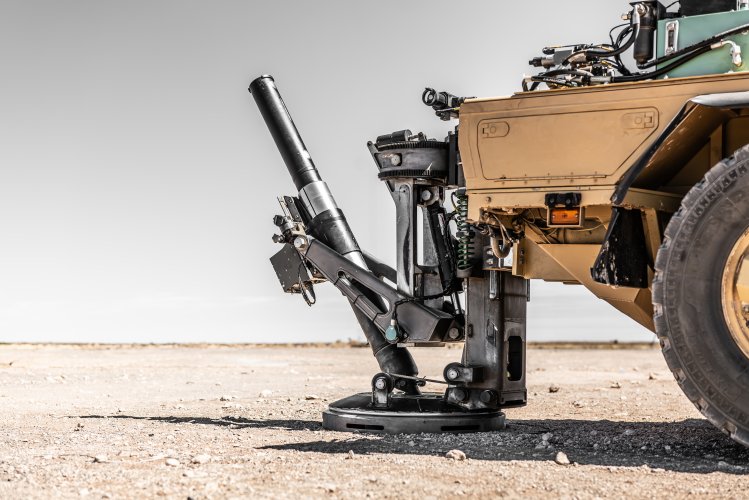
Mortars are now receiving the same treatment. The Ground Deployed Advanced Mortar System (GDAMS) is light and platform-agnostic. It can be brought into and out of action quickly, around 15 seconds with a two-person crew, and features digital controls. It supports both 81 mm and 120 mm tubes, with good accuracy out to 9 km. As crew safety of the mortar remains a concern, a blast diffuser noticeably reduces the blast-over-pressure and acoustic footprint.
“Success belongs to forces that integrate seamlessly— platforms that serve as the MUM-T mothership, drones providing persistent ISR, and mortar systems delivering rapid, shoot-and-scoot fires. This integration compresses decision cycles and gives commanders decisive, uncontested control of the battlespace.”
said Tan Pek Tong, Deputy President, Head, International Defence of Land Systems at ST Engineering.
Smart MRO is transforming sustainment by integrating digitalisation, advanced analytics and intelligent automation to maximise fleet availability, reduce ownership costs and improve operational efficiency. Beyond maintenance, remanufacturing and additive manufacturing capabilities are reshaping supply-chain resilience, addressing obsolescence and extending asset service life through localisation. This approach aligns with the visions of several nations, including Saudi Vision 2030, which aims to localise 50 per cent of military spending — a goal reinforced by the new Supply Chain Zone at defence events.
Training neatly closes the loop, with AI-enabled mixed reality (AR, VR and XR) tools now used for MUM-T, vehicle handling and tactical drills. Less obvious perhaps, but these tools are helping multinational forces work together anytime, anywhere – still one of the hardest things to practise outside operations.
For ST Engineering, the takeaway is clear: the competitive edge comes not from isolated platforms, but from the seamless integration of systems, people, and sustainment to ensure mission success. Through smarter sustainment, unmanned systems, and adaptive protection, we’re shaping the future of warfare. With digitisation enhancing sense-and-strike capabilities, we empower forces to outpace threats by moving information and support faster than ever before.