News
Precision Guidance in Harsh Environments:

Modern military operations increasingly take place in contested, denied, and degraded environments.
Precision navigation and guidance - once heavily dependent on external references such as GPS - must now be sustained under conditions where signals are disrupted, jammed, spoofed, or unavailable altogether. For missiles and unmanned aerial vehicles (UAVs), this reality has elevated the importance of inertial sensing technologies capable of delivering reliable performance independent of external infrastructure.
At the core of these guidance systems are advanced photonic technologies. High-energy laser sources, ruggedized optical components, and inertial sensors such as ring laser gyroscopes (RLGs) provide the stability, accuracy, and resilience required to support mission-critical guidance functions. As missile and UAV platforms evolve toward greater autonomy and longer mission durations, these photonic elements play a central role in enabling assured navigation in the most demanding operational environments.
Inertial Sensing as a Foundation for Modern Guidance Systems
Guidance, navigation, and control (GNC) systems rely on accurate measurement of position, orientation, and motion. While satellite-based navigation systems offer high absolute accuracy under benign conditions, their vulnerability in contested environments has driven renewed focus on inertial sensing as a foundational capability rather than a backup.
Inertial sensors measure motion internally, allowing platforms to maintain navigation accuracy without reliance on external signals.
For missiles and UAVs, this capability directly impacts survivability, targeting accuracy, and mission success. The longer a system can operate autonomously with acceptable error growth, the greater its operational flexibility in environments where GPS availability cannot be assumed.
Among inertial technologies, optical gyroscopes - particularly ring laser gyroscopes - have long occupied the high-performance end of the spectrum, delivering exceptional stability and low drift under extreme conditions.
Ring Laser Gyroscopes: Proven Performance Under Extreme Conditions
Ring laser gyroscopes measure rotation using optical interference within a closed laser cavity. Unlike mechanical gyros, they contain no moving parts subject to wear, enabling long operational life and consistent performance. Compared to lower-cost inertial alternatives, RLGs offer superior bias stability and ultra-low drift, attributes that are critical when navigation accuracy must be preserved over extended periods without external correction.
RLG technology is widely deployed across aerospace and defense platforms, including commercial aircraft, missiles, satellites, and other military vehicles. This broad deployment reflects not only the inherent performance advantages of the technology, but also its maturity and reliability under real-world operating conditions characterized by high shock, vibration, and wide temperature excursions.
Gooch & Housego designs and manufactures defense-grade RLG components engineered specifically for these environments, supporting inertial navigation solutions where performance margins are tight and failure is unacceptable.
Navigation in GPS-Denied and Degraded Environments
The operational importance of inertial sensing is most apparent in GPS-denied scenarios. In modern conflict environments, deliberate jamming and spoofing have transformed GPS degradation from an edge case into a planning assumption. Even in non-combat settings, terrain, urban environments, and atmospheric effects can disrupt satellite signals.
In such conditions, navigation accuracy becomes a function of inertial sensor stability. All inertial systems experience some degree of drift over time; however, the rate at which errors accumulate varies dramatically between technologies. For missiles and UAVs operating autonomously for extended durations, this drift directly limits mission time, targeting precision, and confidence in guidance outcomes.
When platforms transition from a high-accuracy reference point to fully autonomous navigation, gyros with low drift and high long-term stability outperform lower-precision alternatives. This capability is particularly critical for high-value UAV missions, where extended loiter times, complex flight paths, and autonomous decision-making demand consistent navigation accuracy well beyond the limits of short-duration inertial systems.
The Inertial Technology Landscape: Performance Versus Practicality
The inertial sensing landscape encompasses a range of technologies, each optimized for different performance, cost, and integration requirements. Micro-electromechanical systems (MEMS) gyros dominate high-volume, cost-sensitive applications, offering compact size and low power consumption at the expense of long-term stability. Fiber optic gyroscopes (FOGs) occupy an intermediate position, balancing performance and complexity for certain aerospace applications.
Emerging approaches based on photonic integration continue to attract interest, promising reduced size and improved manufacturability. As photonic integration matures, these technologies may play an increasing role in future inertial architectures. However, their long-term stability, environmental robustness, and survivability under extreme aerospace and defense conditions remain areas of active evaluation.
Within this spectrum, RLGs continue to represent a benchmark for high-performance inertial sensing. Their combination of stability, maturity, and demonstrated performance under harsh conditions ensures ongoing relevance for applications where navigation accuracy and reliability outweigh cost or size considerations.
Evolving RLG Technology for SWaP-Constrained Platforms
While RLGs are a mature technology, innovation continues to address emerging platform requirements - particularly the pressure to reduce size, weight, power, and cost (SWaP-C). This trend is especially pronounced in missile and UAV platforms, where payload capacity and power budgets are tightly constrained.
Recent advancements in RLG development have focused on reducing form factor while preserving performance. Achieving this balance is non-trivial; as physical dimensions shrink, maintaining optical stability becomes increasingly challenging. Ultra-flat polishing, precision finishing, and tight control of optical alignment are essential to prevent performance degradation in smaller architectures.
These advances allow RLG technology to remain competitive in applications where lower-performance inertial solutions may meet size or cost targets but fall short on long-term accuracy. For high-value platforms, the ability to deliver reduced SWaP without sacrificing stability ensures continued adoption of RLGs as system requirements evolve.
UAV Proliferation and the Demand for Long-Duration Accuracy
The rapid proliferation of UAVs across military domains has reshaped requirements for inertial guidance systems. While some UAV applications can tolerate modest navigation errors over short missions, others demand sustained accuracy over extended flight durations, often in GPS-challenged environments.
For these high-value missions, inertial performance directly influences operational effectiveness. Low drift and high bias stability enable longer autonomous operation before accumulated error exceeds acceptable thresholds. In this context, RLG-based systems remain well suited to UAV applications where mission endurance, precision, and reliability are paramount.
As UAV platforms continue to diversify - from tactical systems to long-endurance autonomous vehicles - the demand for inertial technologies that balance SWaP constraints with uncompromising performance is likely to persist.
Engineering Stability Inside the Gyroscope
The performance of a ring laser gyroscope depends on the precise interaction of multiple specialized components. Mechanical stability, optical quality, and environmental resilience must be engineered as a unified system rather than optimized in isolation.
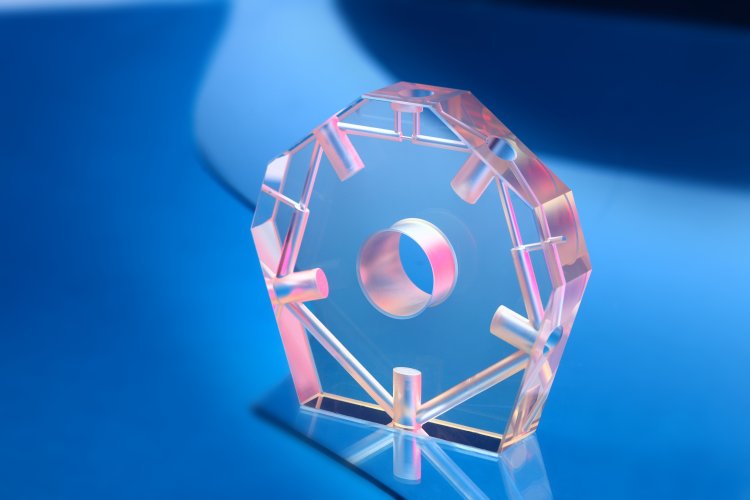
The RLG frame plays a critical role in maintaining geometric stability of the optical cavity. Materials with near-zero thermal expansion are essential to preserve alignment across wide temperature ranges. Zerodur®, a glass-ceramic material widely used in precision optical applications, provides the dimensional stability required for inertial sensing in harsh environments.
Within the optical path, mirrors, beam splitters, prisms, and wedges must maintain ultra-low loss and precise alignment under shock, vibration, and thermal cycling. Superpolishing techniques achieving surface roughness better than 1 Å RMS, combined with high-reflectivity, low-loss ion beam sputtered (IBS) coatings, are critical to sustaining optical performance throughout the system’s operational life.
Vertical Integration and Subsystem Assurance
In aerospace and defense applications, performance assurance extends beyond individual component specifications. Tolerances stack, interactions compound, and long-term reliability depends on consistency across manufacturing processes and production runs.
Vertical integration offers a strategic advantage in this context. By designing and manufacturing the complete RLG component package - including the frame and all critical optical elements - G&H maintains tight control over material selection, process parameters, and quality assurance. This integration reduces sourcing complexity, mitigates supply-chain risk, and supports consistent performance across deployed systems.
Extensive in-house metrology and environmental qualification further support this approach, enabling verification of optical surface quality, geometric tolerances, and environmental resilience at sub-micron and sub-angstrom levels. All RLG components are designed and manufactured in G&H’s Moorpark, California facility, operating under ISO9001 and AS9100 certification and compliant with ITAR requirements - supporting secure supply chains for U.S. and allied defense programs.
Enabling Confidence in Mission Execution
Precision guidance in modern military systems is not achieved through a single technology, but through the integration of multiple subsystems operating reliably under extreme conditions. High-energy laser sources, ruggedized optical components, and inertial sensors such as ring laser gyroscopes form a critical foundation for this capability.
As missiles and UAVs continue to evolve toward greater autonomy, longer mission durations, and operation in contested environments, the demand for high-performance inertial sensing will remain strong. By combining deep photonic expertise, advanced manufacturing capabilities, and decades of experience in aerospace and defense applications, G&H supports guidance system designers in delivering reliable, high-confidence navigation solutions for the most
demanding missions.