News
The Millimetres That Decide Whether a Radar Works

Will-Burt knows there is a reason radar crews still talk about mast movement in millimetres. Not metres. Not degrees. Millimetres.
Ask almost any engineer who has spent time around mobile radar systems what ruins a good sensor and the conversation usually ends up in the same place. Not software. Not processing power. Movement. Tiny amounts of it. A few millimetres at the base of a mast. Slight torsional flex introduced somewhere during integration. A mounting point that behaved perfectly well in the workshop, then spent months vibrating across rough ground on the back of a military vehicle before somebody noticed the imagery drifting or the radar track starting to wander.
That is the problem with elevated sensor systems. Small mechanical issues rarely stay small for long. And the higher modern payloads go, the less forgiving they become.
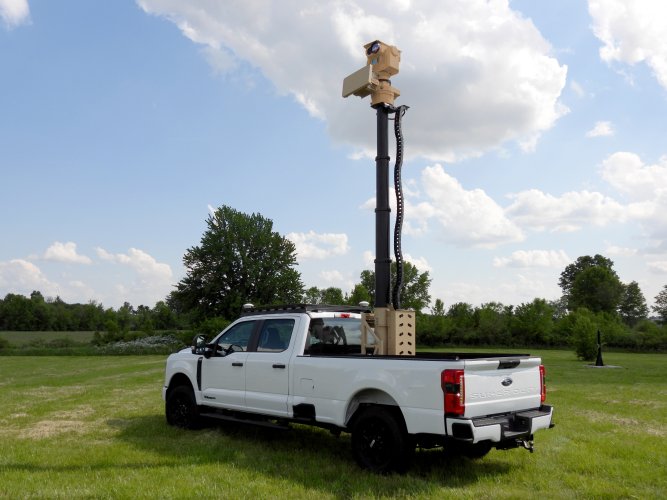
Counter-UAS systems, expeditionary communications nodes, border-surveillance radars and mobile command posts all depend on the same basic requirement, getting sensors, antennas or EO payloads high enough to see what they need to see, while keeping the structure stable enough for the data to remain usable. Once radar and optics are elevated well above a vehicle roofline, tiny movements start becoming much larger ones.
Which is where The Will-Burt Company still finds itself in demand.
Founded in 1918 in Orrville, Ohio, the employee-owned company manufactures telescoping mast systems, tactical trailers, pan-and-tilt positioners and deployable tower infrastructure for defence, security and communications applications, with operations spanning the United States, the United Kingdom, Germany, and Singapore.
Traditionally, that meant supplying the elevation system itself. Increasingly, though, customers appear to be asking for something broader.
“A few years ago most conversations started with, ‘We need a mast, what fits this payload?’”
says David Cotsmire, Chief Marketing Officer at Will-Burt.
“Now it’s more likely to be, ‘Here’s the radar package. Here’s the vehicle, or maybe we haven’t chosen the vehicle yet. We need the whole thing integrated and working properly.’ That’s become much more common.”
It also creates a different kind of engineering workload.
Because once a mast stops being treated as a standalone product and becomes part of a mobile ISR or air-defence platform, the difficult work often sits underneath the sensor rather than above it. Load distribution. Centre-of-gravity changes. Power management. Cable routing. EMI mitigation. Suspension behaviour. Shock isolation. Environmental sealing. Access for maintenance.
One engineer involved in vehicle integration work mentioned spending days resolving a clearance problem caused by two supplier drawings being several millimetres apart. Not glamorous. But it is the sort of detail that decides whether a fielded system behaves reliably or spends its operational life developing faults.
That seems to be where Will-Burt has steadily expanded its role.
Part of that came through acquisition. The addition of Aluma Tower, Integrated Tower Systems and the longstanding inclusion of GEROH under the wider business structure means the company now operates across aluminium telescopic lattice towers, steel telescoping lattice towers, pneumatic mast systems and mechanical mast architectures under a single engineering organisation.
That matters because the trade-offs are rarely straightforward.
Lightweight aluminium systems reduce transport weight and simplify deployment. Steel lattice structures offer rigidity and payload advantages. Pneumatic mast systems allow rapid elevation and compact vehicle integration. Different missions pull those priorities in different directions and, as often happens with defence platforms, the final configuration usually ends up being shaped as much by transport constraints, deployment timelines, available vehicle space and sustainment realities as by the sensor package itself.
“The useful thing for us now is we’re not trying to force one architecture into every application,”
Cotsmire says.
“Some customers are completely weight-driven. Others care more about rigidity, especially once radar gets involved. Sometimes deployment speed becomes the deciding factor because they need the system operational quickly.”
The physics underneath those decisions has not changed much, even if the payloads have.
Will-Burt’s pneumatic mast systems, for example, are designed around stabilised telescoping aluminium sections with internal keyways intended to maintain directional alignment during extension and operation. Larger configurations extend beyond 20 metres depending on payload and wind-loading requirements.
That last point matters more than brochures sometimes admit.
Payload figures on elevated systems are never just payload figures. Sail area matters. Wind loading matters. Vehicle stability matters. Outrigger geometry matters. A mast that performs perfectly well on flat hardstanding may behave rather differently on uneven ground in poor weather.
“If you’re putting radar and optics twenty metres in the air and the structure’s moving around, you’re going to see it in the sensor picture,”
Cotsmire says with a knowing smile.
“At that point you’re chasing stability issues instead of using the system properly. The software can only compensate for so much.”
That emphasis on stability is one reason elevated sensor systems continue appearing in demanding air-defence and surveillance applications. Will-Burt’s mast systems have long been associated with military air-defence, expeditionary communications and persistent ISR roles, particularly were repeated deployment and transport cycles place continuous stress on structures and mounting assemblies.
Nobody inside the company pretends that makes Will-Burt a prime contractor. That is not really the point. The more revealing detail is the sort of environments these systems end up operating in, mobile air defence, expeditionary communications, border surveillance and persistent ISR applications where vibration exposure, repeated deployment and environmental stress are routine rather than exceptional.
The company says its products undergo third-party environmental testing against Mil-STD-810 requirements alongside internal qualification and long-term field evaluation. That includes vibration, shock loading and corrosion exposure, predictable problems for systems expected to spend years mounted on tactical vehicles or trailers.
Some of the work involved is surprisingly traditional.
For all the defence sector’s focus on software-defined capability and autonomous sensing, a great deal still depends on fabrication quality, welding consistency and whether assemblies behave properly after repeated transport cycles. Several defence manufacturers now outsource parts of that mechanical integration work because it is time-consuming, specialised and awkward to scale internally.
“Some of the bigger companies don’t necessarily want engineers tied up solving mounting problems or trailer interfaces,”
continues Cotsmire.
“But somebody still has to make all that hardware work together in the real world. We’ve been building and fabricating these kinds of structures for a long time.”
There is probably a wider point underneath that.
Defence procurement discussions tend to focus on sensors, effectors, software and autonomy layers because those are the visible technologies attracting investment. The physical infrastructure supporting those systems receives far less attention, despite often determining how well the capability performs once deployed.
A radar mounted on an unstable platform does not become less unstable because the processing software improves. An EO payload does not stop vibrating because the sensor itself is expensive. Eventually the engineering underneath the system catches up with the electronics sitting on top of it.
Which brings things back to millimetres.
Not because mast movement sounds dramatic in a specification sheet, but because modern sensor systems increasingly operate in environments where tiny alignment errors become operational problems very quickly. A bracket slightly out of tolerance. A structure flexing more than expected. A vehicle settling unevenly after deployment. As Will-Burt knows all too well, usually, that is where the performance difference starts.