News
MOVING FROM HOPING WE ARE READY TO KNOWING WE ARE:

Hyper-realistic, zero-risk simulation is quietly revolutionising radiological preparedness worldwide.
Radiological risk tends to lurk in the background. It’s always there, seldom makes the front page, yet no one in the business can afford to forget it. Whether the threat comes from ageing legacy facilities, busy hospitals, civil nuclear stations or the remote but real prospect of malicious use, the debate has moved on. We’re no longer asking whether we should train for these events; we’re asking how to do it properly.
“At Argon we’re driven by a very simple idea,” says Laura Wells, Argon Marketing Manager. “We give the people who keep the public safe the ability to train as realistically as possible, wherever and whenever they need to, without ever putting a single person at unnecessary risk.”
For decades the default answer was to bring out a few sealed or low-activity sources and walk through the motions. It was better than sitting in a classroom, but anyone who has stood in a real control room while dose-rate alarms climb knows how thin that pretence really is. The shrill, accelerating chirp of a high-range instrument, the hurried recalculation of stay-time, the sudden order to pull everyone back, none of that comes alive with a couple of microcuries and a clipboard.
That’s the gap Argon Electronics has spent decades trying to close.
Its mission has remained constant: to give the people charged with keeping the public safe a way to train as if the threat were real, without ever putting themselves or anyone else at risk. From the dockyards at Devonport to hospital emergency departments in Truro, and from NATO exercises in Bulgaria and the teams preparing training approaches, the same principle has driven every simulator Argon has built: real detector responses, proper inverse-square fall-off, credible shielding effects, wide-area plume dispersion with PlumeSIM, yet not one ionising photon involved.
“Our simulators are exact replicas of real detectors, matching both appearance and functionality,” explains Felipe Arrighi, Director of Business Development at Argon Electronics. “The only difference is a blue section, which signals under NATO rules that the device is for training. This means emergency response teams can train with the same equipment they use in the field, in a setting that closely mirrors a real radiological emergency.”
What you get is training that finally feels like the real thing.
Before high-fidelity simulation became mainstream, a major site exercise might look impressive on paper: survey teams deployed, contamination plots marked, cordons established, checklists signed off. But the instruments rarely moved above background. No one’s pulse quickened. No one experienced the cold moment when a reading won’t drop, and you have to decide whether to send the next team in or stand them down. When police, fire, ambulance and site security all turned up, the quiet misunderstandings that undermine multi-agency coordination stayed comfortably out of sight. In the wash-up someone would always ask, “Are we actually ready?” The honest answer was usually, “We think so.”
Simulation brings much greater certainty.
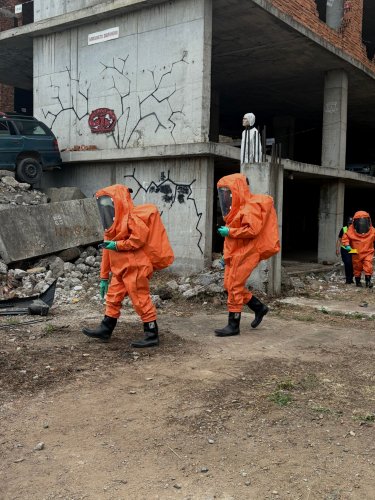
With Argon’s systems, an instructor can script everything from a reactor coolant leak to a radiological dispersal on a city street. Contamination can be mapped across an entire naval base; teams respond exactly as they would if readings were genuine. Personal dosimeters accumulate dose in real time. PlumeSIM lets exercise directors see where every participant is, what their instruments are showing, and, most importantly, how they make decisions when the clock is ticking.
“Staying safe during nuclear or radiological emergency training is crucial, especially when the scenario becomes stressful,” adds Felipe Arrighi. “To achieve this, responders need training tools that feel genuinely real and build true situational awareness.”
The deepest lessons surface later, in the debrief room. Dose histories reveal who lingered too long in the hot zone. GPS tracks show when a cordon was placed incorrectly because an isotope signature was misread. Radio logs pinpoint the moment a vital warning never reached the fire commander. These are not hypothetical errors; they mirror the mistakes seen in real incidents. Now they can be exposed and fixed long before anyone is at risk.
Regulators are paying attention.
When Royal Cornwall Hospital published its experience of adopting simulator-based training, the inspector noted that using radioactive sources added avoidable risk and was not in keeping with the spirit of ALARP. At NATO’s BULGARIA 2025 exercise, multinational teams who believed they were well-rehearsed discovered, under blind, high-activity scenarios, that rescue crews were being sent towards dangerous radiation fields because warnings were not relayed. Simulation uncovered the flaw without harming anyone.
None of this replaces real sources where they are genuinely required, calibration, type-testing and certain regulatory checks. But for the training that matters most, building situational awareness, practising decision-making under pressure, and ensuring agencies work together effectively, simulation is increasingly becoming the benchmark.
The momentum is clear.
Lawrence Livermore National Laboratory has granted Argon an exclusive commercial licence for the RaFTS spectral-training technology, while the Department of Energy, AWE and UKHSA have all supported Argon in developing its simulation technology. Several detector manufacturers are now incorporating simulator compatibility into their instruments from the earliest design stages. Even large, long-term submarine programmes such as Dreadnought and SSN-AUKUS are already prompting early discussions about how future crews can train realistically without relying on high-activity sources.
Every so often you still hear the old refrain: “Only real radiation trains real people.”
One conference provided a quiet rebuttal. A group of radiation-protection advisers were demonstrating Argon’s gamma simulator. After switching off the simulated source, the detector continued to show elevated readings. The audience assumed an unexpected real hazard had appeared. The operator traced the signal across the hall, only to find that an OEM partner had been running its own simulator for demonstrations and had left it on, producing strong simulated activity from afar. The confusion was real. The readings were real. The dose was zero.
That small, slightly comic episode captures Argon’s purpose: to build training tools so convincing that even experts respond instinctively, then use them to ensure that when the alarm is real, no one is facing the unknown for the first time.
A quiet revolution in radiological training is already under way. Across civil nuclear, defence and emergency response, the people responsible for safety now have tools that turn “I hope we’re ready” into “We know we are.” The only remaining question is how quickly everyone else catches up.