News
Quietly Critical:

From lifecycle resilience to high-speed VPX and SOSA-aligned architectures, Interface Concept has built its reputation on hardware that keeps going as programmes, platforms and requirements change.
Some companies grab the headlines; others just get on with it, becoming part of the kit engineers rely on day in, day out. Interface Concept is definitely in that second camp. Whether it's radar processing, mission computing, networking backplanes or subsystem integration, their boards are usually there doing a simple job: shifting data reliably, putting up with rough conditions and staying supportable long after the original plans are old news.
Founded back in 1987 and based in Quimper, the company has spent nearly four decades designing and making embedded boards and systems for defence, aerospace and tough industrial settings. In this line of work, longevity isn't about flashy branding, it's a must. Platforms stick around for decades, while needs shift, parts go obsolete and supply chains get shaken up.
IC has a straightforward, methodical way of doing things.
The company takes a proactive approach to obsolescence, tracking component status, arranging last-time buys, qualifying second sources and planning redesigns well in advance. Where possible, compatible parts are introduced as straightforward substitutions; where that is not viable, PCBs are adjusted to accommodate alternatives or components are stockpiled to bridge supply gaps. For higher-volume programmes, form, fit and function replacements are offered, and for platforms unable to absorb that change, then dedicated storage options can be put in place. It is a practical, methodical model familiar to anyone involved in sustainment or mid-life upgrades, underpinned by long-term technical support spanning hardware, low-level software, repairs and lifecycle commitments that frequently extend beyond a decade.
Evolving architectures: VME, VPX and FPGA
Interface Concept’s products have evolved alongside broader trends in embedded defence electronics. VME was the mainstay for loads of older mission systems, while VPX, OpenVPX and SOSA profiles are now key for newer ones, thanks to demands for more bandwidth and better interoperability.
“We’ve kept an eye on emerging standards,” Brigitte Jousselin, in charge of Marketing & Communication Interface Concept said. “We brought in VPX designs not long after the standard came out, and by 2010 we were shipping a 6U VPX Ethernet switch and single-board computers.”
At the same time, the company has continued to invest in VME, recognising that many deployed platforms will remain in service for years to come. The architecture is still widely used, and new Intel Tiger Lake and Arm-based VME boards are being introduced alongside an updated Ethernet switch range, including VITA 31.1 variants. This two-pronged strategy reflects operational reality: naval vessels, aircraft and land systems rarely undergo wholesale architectural replacement, resulting in mixed environments where backward compatibility is essential.
Networking at the centre of the system
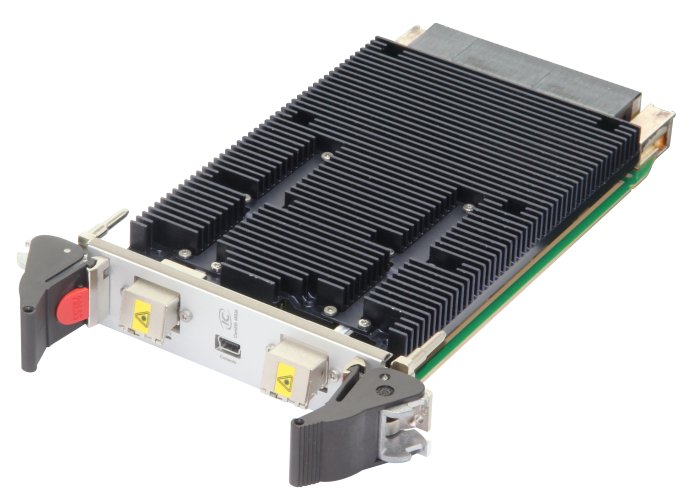
IC’s ComEth Ethernet switch and router family is central to their networking lineup. It comes in 3U and 6U VPX, plus VME and CompactPCI formats, scaling from 1 GbE up to 100 GbE, with support for copper, fibre, optical front panels and VITA 66.5 interfaces. Setups include Layer 2 and Layer 3 switching, dual-plane designs and hybrid Ethernet/PCIe fabrics. In data-heavy sensor setups like ISR payloads, EW suites and distributed processing nodes, the switch basically becomes the backbone rather than just a link.
On top of the hardware, sits their in-house Switchware management stack, offering CLI, GUI and SNMP interfaces with a solid feature set. Having the hardware and control software tightly aligned cuts down on the usual hassle of shoehorning third-party products into platforms they weren't built for.
Compute density and flexible processing
For compute, IC’s SBC and DSP range covers Intel Xeon D and Xeon W processors, plus the Arm-based ones using NXP Layerscape and QorIQ chips. Standard setups include ECC-protected memory, high-speed Ethernet, PCIe links and, in some cases, onboard FPGAs for acceleration or custom interfaces. FPGA-centric platforms, like front-end processing boards with AMD Kintex, UltraScale and Versal devices, handle deterministic processing and low-latency data. FMC and FMC+ mezzanine support lets you add modular I/O without redoing the base board.
But performance is only half the story. Thermal management, mechanical limits and ruggedisation are make-or-break, not should-have, especially in conduction-cooled setups.
As Lionel Provost, Strategy and Marketing Vice-President, put it: “We invest in cutting-edge embedded technologies while preserving our added value in the system’s critical elements, including thermal management, performance and modularity.”
In-house control and sovereignty considerations
With cybersecurity ramping up and supply chains under the microscope, procurement choices are shifting. Interface Concept’s focus on internal development ties into both technical and strategic needs, with hardware design, firmware, bootloaders and board support packages all done in-house.
“We keep a secure development chain,” Mikelig Roudaut, Sales Director Interface Concept continues “Hardware, firmware, bootloader and BSP are all controlled internally, which helps with code integrity and cybersecurity goals. We also stick to European design and manufacturing, with our own export-control know-how covering ITAR and EAR.”
This fits the growing push in NATO and allied programmes for sovereignty and clear software origins.
Open standards, applied pragmatically. The company slots its portfolio into open architectures, especially VPX, OpenVPX and SOSA principles.
“The SOSA Technical Standard and MOSA approach are reshaping defence systems by enabling faster integration and long-term availability,” Lionel, said recently “We aim to support that shift with a field-proven portfolio of SOSA-aligned solutions.”
That said, the company knows formal standards sit alongside programme-specific needs and wider frameworks like STANAG. In the end, aligning with standards has to be balanced against optimising performance and fitting mission limits.
Agility and engineering depth
In a market with big multinationals and specialist niches, IC sets itself apart with quick decisions and solid expertise.
Mikelig sums it up “Fast decision cycles, strong low-level software and hardware know-how, and a wide portfolio. Customers like an ecosystem that covers switches, SBCs, FPGA platforms, firmware, BSPs and long-term support.”
It's a straightforward pitch, but it matches how long-term customers see the company: solid expertise, ongoing commitment and steady improvements. More often than not, that comes down to hardware that just keeps working through upgrades, redesigns and years of service. For engineers juggling performance, interoperability and longevity, that history is the reassurance they depend on.