News
When Five Tonnes Decline to Slow on Demand

In discussions about civilian armoured vehicles, people tend to focus on the obvious measures of protection, armour ratings, glazing, and external security indicators. That’s important, of course, but the systems you don’t immediately see can be just as critical for keeping the occupants safe. Braking performance is a perfect example.
The issue came into sharp focus at the 4th Annual CAV Forum in Geneva, where specialists, End Users and engineers examined how armouring alters vehicle dynamics in ways that are sometimes acknowledged, sometimes glossed over. Sascha Lucas of MOV’IT High Performance Brakes tackled it head-on, focusing not on marketing claims or component aesthetics but on the physics governing deceleration in high-mass platforms.
Because once armour is added, the numbers change rather quickly.
A production SUV designed around a gross vehicle weight in the region of three tonnes can, after conversion to higher ballistic levels, exceed five tonnes. The increase isn’t incremental; it is transformational. Kinetic energy rises with the square of speed and scales with mass, so braking events that were comfortably within the thermal capacity of the OEM brake system can begin to drive temperatures into regimes where fade, pad degradation, and inconsistent pedal force to braking ratio appear. Not immediately, perhaps. But under repeated load cycles.
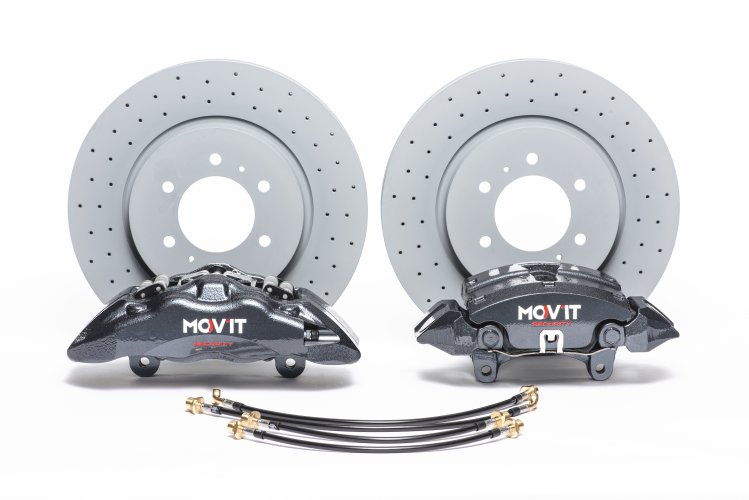
Lucas’s argument was measured and, frankly, difficult to dispute. Larger rotors and multi-piston callipers are not a shortcut to shorter stopping distances; tyre grip and ABS thresholds remain decisive. The engineering challenge lies elsewhere – heat dissipation, stiffness under pressure, friction stability at elevated temperatures, and repeatability across successive braking events.
Repeatability matters more than peak figures.
Thermal management, in particular, becomes unforgiving in armoured vehicles. Each high-energy stop converts substantial kinetic energy into heat. Without sufficient rotor mass, ventilation, and pad material resilience, temperatures climb quickly. As they climb, friction coefficients drift. Pedal travel lengthens. Driver confidence erodes. It is rarely one dramatic failure; more often a gradual softening, a hint of inconsistency, the sense that something is not responding quite as crisply as it should.
Uncertainty creeps in.
These considerations sit squarely within the operational territory of TSS International. Established in 1976 in the Netherlands, TSS has long positioned itself around what it terms “Armour Mobility”, a practical recognition that protection is compromised if a vehicle cannot maintain control, manoeuvrability, and mechanical reliability under increased mass and altered load distribution.
Brakes are central to that equation.
TSS’s approach has historically centred on runflat systems, heavy-duty wheel assemblies, and associated mobility solutions, but braking upgrades have become an increasingly important element as vehicle weights continue to rise. Partnerships with specialists such as MOV’IT GmbH reflect a systems-level view: braking performance cannot be treated as an isolated upgrade bolted onto an otherwise unchanged platform.
Everything interacts. Tyres, suspension, axle loads, brake balance.
And this is where the conversation becomes, admittedly, a little less tidy. Because once you begin tracing cause and effect, increased kerb weight leading to higher kinetic energy, leading to elevated brake temperatures, leading to potential fade, leading to longer stopping distances, leading to greater tyre load transfer, leading to altered stability margins, you realise how quickly “just fit bigger brakes” reveals itself as an incomplete and unsatisfactory answer.
It rarely is that simple.
TSS’s broader portfolio reflects that interconnected reality. Heavy-duty wheels address higher static and dynamic loads. Runflat systems preserve mobility after tyre damage. Suspension enhancements compensate for mass and centre-of-gravity shifts. Self-sealing fuel tanks mitigate secondary risks associated with ballistic threats. Each subsystem, while distinct, contributes to maintaining predictable vehicle behaviour.
Predictability. That’s the thread running through all of it.
The CAV Forum discussions reinforced a shift already underway within the sector. Buyers and operators are asking different questions now. Less emphasis on component dimensions or piston counts, more on thermal curves, fade resistance, and behaviour under repeated braking cycles. How does the system respond after successive high-energy stops? Does pedal travel remain stable? Is brake balance preserved as axle loads change with armour distribution? These are not abstract concerns. Civilian armoured vehicles spend much of their service life in dense urban traffic, executing frequent low-speed stops interspersed with occasional high-load braking events. Add gradients, high ambient temperatures, variable road surfaces, the duty cycle is neither gentle nor predictable.
Which is precisely the point.
Perhaps the most useful takeaway from Lucas’s presentation was not a specific technical detail but a framing: braking systems in armoured vehicles are not performance accessories. They are safety-critical controls operating under conditions for which the original vehicle was never designed.
A subtle distinction, but an important one.
In protective mobility, success rarely announces itself as a distinct dramatic moment, there is no visible confirmation that accompanies accomplishment. It is present instead in the absence of incident, the vehicle that slows consistently, the driver who trusts the pedal response, the occupants who remain unaware of the thermal and mechanical margins being quietly managed beneath them. It’s not glamorous, just dependable, and in this field, dependable is exactly what you want.